
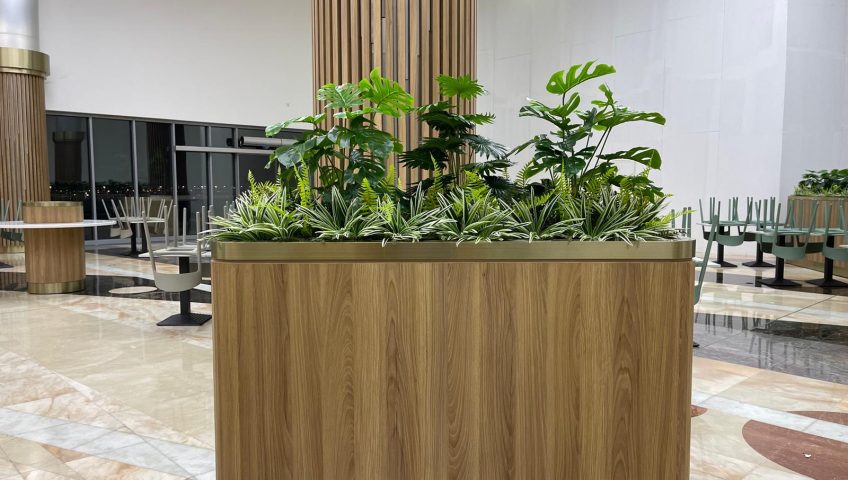
Take a look at the photos below. Would you have guessed the plants were artificial if we had not told you? <!–more–>
You might spot a clue. You might want a closer look. That is part of the fun.
These photos come from ASTA’s own gallery in Qatar. From a busy food court to a sculpted bonsai tree, each shows a different way to use realistic artificial plants indoors.
A closer look at Doha Mall Food Court

Start with the leaves. The broad monstera foliage sits above finer ferns and striped leaves, with palms filling the middle. Some stems lean into the space; others disappear into the planting.
That variation gives your eye something familiar to follow. A garden rarely grows at one height, and the planting here has that same sense of layers.
The wooden planters also belong to the room. Their finishes sit comfortably alongside the surrounding columns and seating, so the greenery feels connected to the interior.
There is a practical reason for the arrangement, too. In a food court, people need room to move and places to sit. Greenery can help define those areas while leaving the space open. You can see more of the installation in our Doha Mall Food Court project gallery.
A bonsai tree with room to spread

Your eye might go straight to the trunk here. It twists through the centre of the tree, with knots and openings that break up the surface.
The foliage has a different rhythm: dense clusters of green sit at several heights, with clear gaps between them. You can follow the branches instead of seeing one solid block of leaves.
This is a more deliberate, sculptural look than the mixed planting at Doha Mall. It suits a space where you want one piece of greenery to be the focal point.
Scale matters with artificial trees. This ASTA bonsai is 150 cm high with a canopy about 210 cm wide, so it needs room to spread. You can see the dimensions and more details in our wide canopy artificial bonsai gallery.
Greenery beside the table at Lemon Garden

Now imagine sitting beside this planter for an hour. You would have plenty of time to notice the foliage.
At Lemon Garden Restaurant in West Bay, patterned leaves and ferns fill the lower part of the arrangement, while taller eucalyptus-style stems rise above them. The different shapes keep it from looking like a row of identical plants.
The planter sits between seating areas, giving neighbouring tables a little separation while keeping the dining room visible. It is a good example of artificial plants doing something useful in a room as well as adding colour.
When greenery will be this close to guests, the finish deserves a careful look. Leaf edges, visible stems and the way each branch is positioned all become easier to see. Our Lemon Garden project gallery shows the arrangement in its restaurant setting.
What gives artificial plants away
Sometimes you can tell immediately. Repeated leaf shapes, exposed plastic joints or branches left tightly folded after transport can make an otherwise attractive plant look unfinished.
Lighting can reveal those details. A little shine is natural on some leaves, but a strongly reflective surface may look very different beneath a spotlight than it did in a catalogue.
The simplest check is to view the plant from where people will actually spend time. Stand at the entrance, then sit beside it. Look at the base as well as the canopy. A convincing installation should hold together from those everyday angles.
If you are comparing artificial plants in Qatar for your own space, our guide to choosing realistic artificial greenery goes into more detail on scale, materials and placement.
A few questions about artificial plants
Can artificial plants look real up close
They can look convincing, although close inspection may still reveal the materials. Natural variation, careful shaping and a neatly finished base all help. A photo is a useful starting point, but seeing a sample under your own lighting gives you a better idea.
What should I check in artificial plants that look real
Look beyond the overall shape. Check the leaf texture, branch connections and any trunk that will remain visible. Then consider how the plant fits its planter and the room around it. The finished arrangement matters as much as the individual plant.
Do artificial plants need maintenance
They do not need watering, pruning or sunlight to grow. They still collect dust, so occasional cleaning helps keep the foliage looking its best. Follow the Asta’s care instructions for the particular material.
Which one made you look twice
The layered planting at Doha Mall, the wide canopy bonsai, or the greenery beside the tables at Lemon Garden? Three different looks, with plenty of small details to notice.
If you have a corner, seating area or entrance that could use some greenery, get in touch with ASTA. Share a photo of the space and we can discuss an artificial plant or tree installation that suits it.